Stonehenge - by Gavin Ferguson
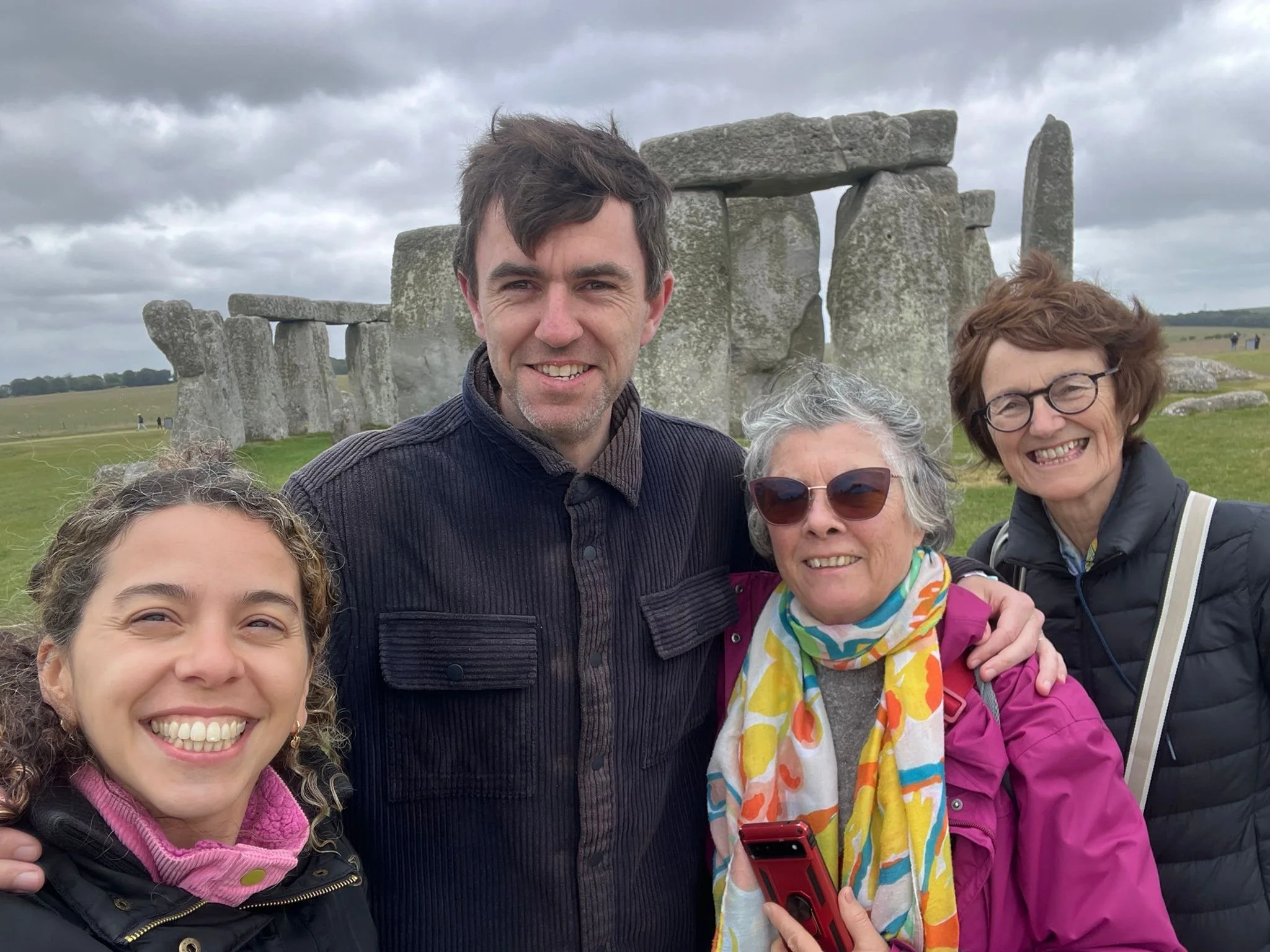
Wife, me, friend, mum
Where did we go and why?
I often put off buying my wife’s birthday present right until the last minute. This year, a couple of minutes before the clock struck midnight on the night before her birthday, I panicked and bought us tickets to see Stonehenge. In hindsight, I’m not sure if this was more of a gift for me or for her – anyway, she was happy and that’s all that matters. I also bought tickets for my mum and our family friend, Yasmin.
How did we get there?
I do have a driver’s license but I absolutely detest driving. My lack of experience causes my nervousness and my nervousness prevents me from gaining experience – it’s a catch 22. I felt a bit pathetic and unmanly when I asked my mum to drive us there instead of me.
What were the staff like?
When you arrive, the first thing you do is go into the Stonehenge museum. As we walked in, I overheard one of the museum staff saying to another ‘I absolutely relish questions’. I headed over to him and started asking him questions about Stonehenge and he responded with boundless enthusiasm and knowledge. His name was Harry. As other visitors shuffled through the museum, listening to an audio guide and reading captions, I felt like they were missing a trick by not speaking to Harry. What a joy it is to speak to someone with such expertise and passion, what a wonderful way to learn.
Asking Harry questions about Stonehenge felt like playing fetch with a Labrador. I would throw him a question and he would go and fetch his answer with boundless enthusiasm. After about 15 minutes, I felt like I should stop hogging Harry and let someone else have the chance to benefit from his wisdom. Upon finishing his answer to my final question, he stood there wagging his tail, eagerly awaiting the next one… I shook his hand and thanked him for a wonderful conversation.
What do we know about Stonehenge?
Harry’s favourite fact about Stonehenge is that we don’t have the foggiest idea what its original builders used to call it. In fact, we don’t know much about Stonehenge at all. Here is what we do know:
- The main stones that we can see were put there in 2500BC
- The earliest phases of construction began in 3100BC
- The monument is aligned to the summer solstice and winter solstice
- There were similar monuments built at the same time all over Britain
- Some of the stones came all the way from Wales and even Scotland
Pretty much anything you hear about Stonehenge beyond these basic facts is pure speculation. I was happy to see Stonehenge with my own eyes and feel this part of our history.
What did we have for lunch?
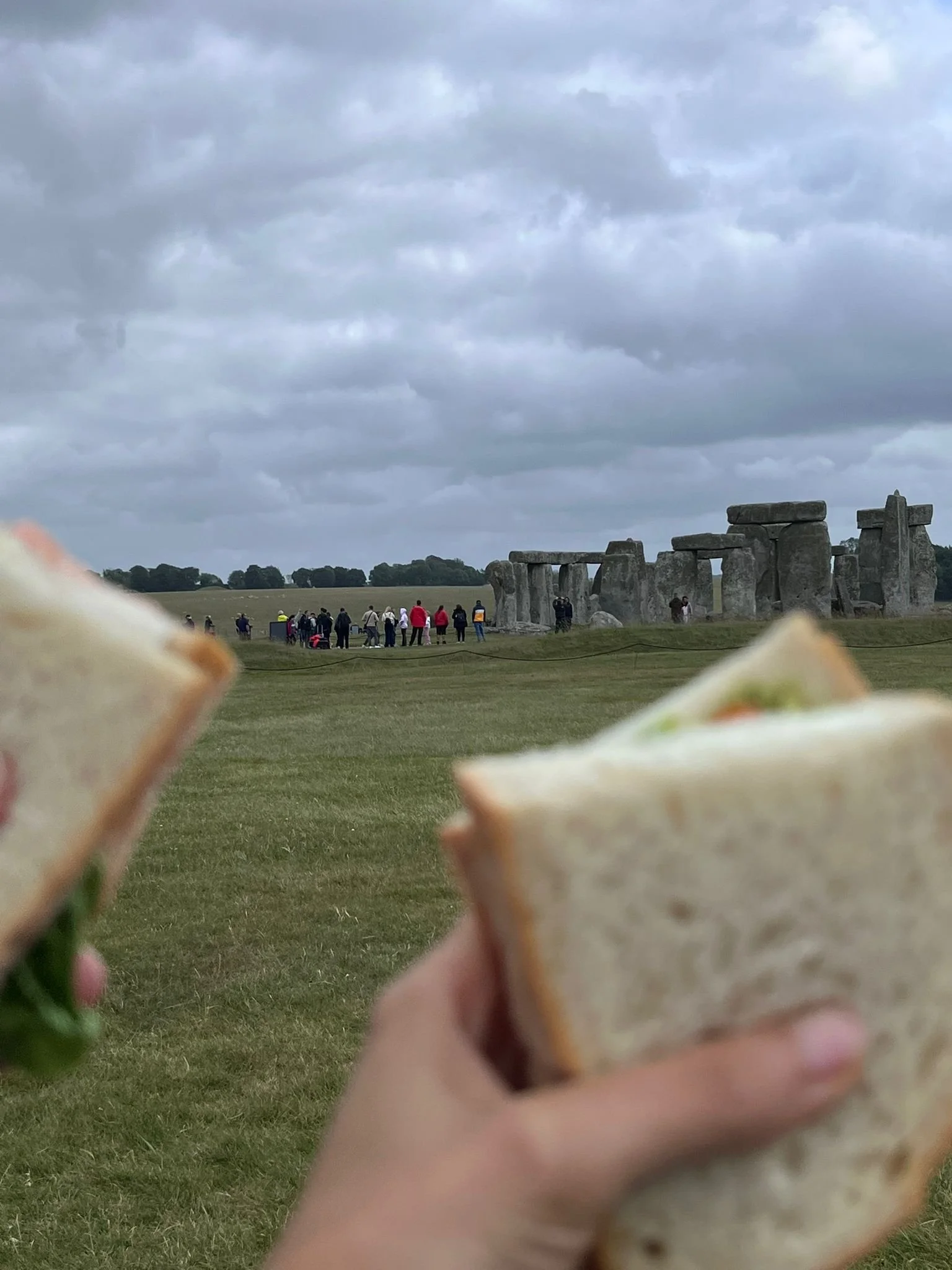
My mum loves making me sandwiches, and looks for any excuse to make me them. ‘We’re going to central London so I’ll make sandwiches’; ‘we’re going to the airport so I’ll make sandwiches’; ‘we’re going to Stonehenge so I’ll make sandwiches’.
I’ve been eating my mum’s sandwiches for a long time. She started making them for me for my packed lunch in primary school. I’m ashamed to say that in secondary school, I used to sell my mum’s sandwiches for £1 each and then use the profits to buy chocolate. She wasn’t made aware of this illicit trade until long after I had left school.
She makes different types of sandwiches – cheese, ham & cheese, tuna, chicken, salmon, egg mayonnaise. Recently, my wife asked me which was my favourite, but I couldn’t answer – I’ve eaten so many of them that all of the flavours have just blurred into one.
We all sat on a bench facing Stonehenge and tucked into my mum’s sandwiches. Even though it feels like I’ve been eating them since before the first stone of Stonehenge was laid, and I used to flog them for a quid at school, I do love her sandwiches with all of my heart.
Who is Arthur Uther Pendragon?
There is an ancient Celtic pagan religion called Druidry which is often associated with Stonehenge. You may think this religion died out a long time ago, but it hasn’t, because there is a 72 year-old man called Arthur Uther Pendragon who claims to be its leader. He also claims to be the reincarnation of King Arthur, an ancient mythological King who never actually existed.
Mr Pendragon has been involved in constant legal battles with the government over the years, claiming that the fact that he is being charged to visit his place of worship (Stonehenge) is a breach of his human rights.
I would love to meet him. I’m intrigued to know whether he actually believes he is King Arthur or not.
This is a list of key vocabulary and expressions from the article in order of how useful they are. The student must choose 6 items from the list to study in the lesson.
Lack
• Definition: A shortage or absence of something needed or desired.
• Example: “There is a lack of evidence to support that claim.”To be eager (to do / be something)
• Definition: To be very keen, enthusiastic, or excited to do something or to experience something.
• Example: “She is eager to start her new job next week.”I've been eating my mum's sandwiches for a long time
• Definition: This is the present perfect continuous tense, used to describe an action that started in the past and is still continuing now, with emphasis on duration.
• Grammar structure: have/has + been + verb-ing
• Example: “I’ve been studying English for a long time, so I feel more confident now.”Beyond
• Definition: Further than; outside the limits of; or more than something in degree or ability.
• Example: “The village is beyond the mountains.”Pretty much
• Definition: Almost; nearly; more or less.
• Example: “I’ve pretty much finished my homework, I just need to check it.”To head (somewhere)
• Definition: To move or travel in a particular direction or toward a place.
• Example: “We’re going to head home after the film.”To love (someone/something) with all your heart
• Definition: To love someone or something completely and deeply.
• Example: “She loves her family with all her heart.”I do love her sandwiches
• Definition: This uses do/does/did + base verb for emphasis, to make a statement stronger or more emotional.
• Grammar structure: do/does/did + base verb (for emphasis)
• Example: “I do want to go to the concert, even if I’m tired.”To overhear (someone/something)
• Definition: To accidentally hear what other people are saying without them knowing.
• Example: “I overheard them talking about the surprise party.”A quid
• Definition: Informal British slang for one pound sterling (£1).
• Example: “This snack only costs a quid.”Worship
• Definition: To show deep respect, admiration, or religious devotion toward someone or something.
• Example: “Ancient cultures worshipped many different gods.”To put (something) off
• Definition: To delay or postpone something.
• Example: “I keep putting off my dentist appointment.”To relish (something)
• Definition: To enjoy something greatly or take great pleasure in it.
• Example: “He relishes a good challenge.”Manly
• Definition: Traditionally masculine; showing qualities associated with men such as strength or toughness.
• Example: “He tried to sound manly by speaking in a deeper voice.”In hindsight
• Definition: Looking back at a past event with understanding that you didn’t have at the time.
• Example: “In hindsight, I should have taken the earlier train.”To be intrigued
• Definition: To be very interested or curious about something.
• Example: “I was intrigued by the mystery in the story.”To detest (something/someone)
• Definition: To strongly dislike something or someone.
• Example: “She detests being late.”To wag your tail
• Definition: When a dog moves its tail from side to side, usually to show happiness or excitement.
• Example: “The dog wagged its tail when it saw its owner.”To hog (something)
• Definition: To take or use something selfishly and not share it.
• Example: “He hogged the remote control all evening.”To flog (something)
• Definition: (Informal) To sell something, often quickly or aggressively; or to promote it strongly.
• Example: “They’re trying to flog their old car online.”I haven’t the foggiest
• Definition: I have no idea at all; I don’t know anything about it.
• Example: “I haven’t the foggiest what he’s talking about.”To tuck (into something)
• Definition: To eat something with enjoyment and enthusiasm.
• Example: “We tucked into a big roast dinner.”A catch 22
• Definition: A situation where you cannot solve a problem because the solution depends on something that is also impossible.
• Example: “It’s a catch 22: you need experience to get a job, but you need a job to get experience.”Boundless
• Definition: Without limits; infinite or very great.
• Example: “She had boundless energy during the trip.”To miss a trick
• Definition: To fail to take advantage of an opportunity.
• Example: “He never misses a trick when it comes to business deals.”
15 conversation-provoking questions related to the article.
1. Where did we go and why?
2. How did we get there?
3. What were the staff like?
4. What do we know about Stonehenge?
5. What did we have for lunch?
6. Who is Arthur Uther Pendragon?
7. How do you feel about driving?
8. What type of days out do you enjoy?
9. Are you fed up with your partner’s cooking?
10. What did you eat at school?
11. What historical sites can we visit in your native country?
12. Would you be up for visiting Stonehenge?
13. Are you as enthusiastic about your work as Harry is?
14. Do you always leave your gift buying until the last minute?
15. What is your learning style?